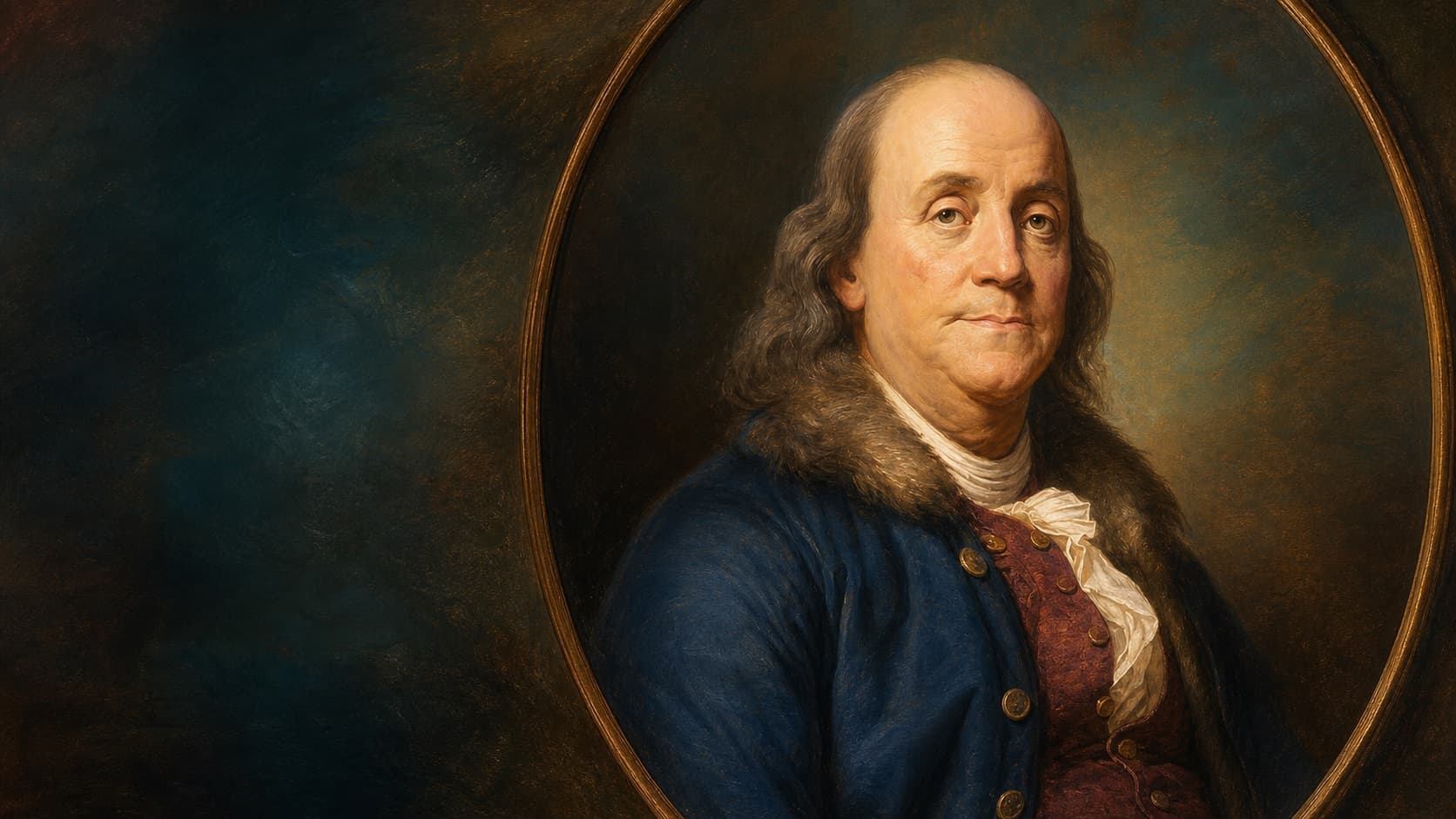
BenjaminFranklin
Benjamin Franklin spent eighty-four years repeatedly remaking himself: a runaway apprentice who became a printer, a civic organizer who became an experimental scientist, and a colonial loyalist who helped found a republic. This journey follows the connections between those lives. Each new role grew from the same habit—observe closely, test an idea in public, then build a practical system others could use.
Printer. Experimenter. Diplomat.

Before thestatesman
Franklin was born in Boston on January 17, 1706, the fifteenth of Josiah Franklin’s seventeen children. His formal schooling ended after two years because the family could not afford more, but books gave him a private education. Work in his father’s candle shop sharpened his impatience for another life. That hunger for reading led directly to the trade that would teach him how ideas travel.
The fifteenth of seventeen children.
Ink underhis nails
At twelve Franklin was bound to his older brother James, printer of the independent New-England Courant. He learned composition, presswork, distribution, and the power of an argument in print. Barred from contributing openly, he invented the middle-aged widow Silence Dogood and slipped her essays under the shop door. The deception proved his voice could command attention; conflict with James then pushed him to leave Boston illegally.
Apprenticed to his brother James at twelve.
Three rolls.A new city.
Franklin reached Philadelphia in October 1723 after a difficult journey through New York and New Jersey. Seventeen, disheveled, and almost penniless, he walked along Market Street carrying three bread rolls and eating one. The comic humility of that entrance mattered to the older Franklin, who remembered it against his later prosperity. Philadelphia offered looser hierarchies, active presses, and the room to turn skill into independence.
Seventeen, tired and nearly unknown.
A printerabroad
Governor William Keith encouraged Franklin to buy printing equipment in London but failed to provide the promised credit or introductions. Stranded, Franklin found work at Samuel Palmer’s and John Watts’s printing houses from 1724 to 1726. London exposed him to skilled journeymen, religious dissent, coffeehouse debate, and metropolitan publishing. The disappointment taught him to distrust patronage and rely instead on craft, discipline, and relationships among working people.
Promised backing never arrived.
Print becameinfrastructure
Back in Philadelphia, Franklin entered a printing partnership and soon established his own shop. He founded the Junto, a weekly club where tradesmen debated questions and converted discussion into civic projects. He acquired the Pennsylvania Gazette in 1729 and helped create the subscription Library Company in 1731. Print, conversation, and shared books now formed one system: information could improve both an individual livelihood and an entire city.
A partnership became his own shop.
Useful ideas,widely printed
Beginning in 1732, Franklin published Poor Richard’s Almanack under the persona Richard Saunders. Its calendars, weather, practical advice, and memorable proverbs reached a broad public and helped make him financially independent. He used that freedom to organize institutions: the Union Fire Company, an academy that became the University of Pennsylvania, support for a hospital, and improved postal service. Private success became fuel for durable public cooperation.
Poor Richard began in 1732.
Lightningmade legible
After retiring from daily printing, Franklin devoted more time to natural philosophy. He helped establish the American Philosophical Society and developed a theory of electrical charge through repeatable experiments. In 1752 his kite apparatus collected charge from a storm cloud—without being struck by lightning—supporting the connection between lightning and electricity. The lightning rod followed: abstract knowledge translated into a device that protected buildings, ships, and lives.
An academy of inquiry became the APS.
Join,or divide
In 1754 delegates from seven colonies met at Albany to discuss defense and relations with the Haudenosaunee during mounting conflict with France. Franklin proposed a shared grand council under a president-general, giving colonies a mechanism to coordinate common affairs. Neither the Crown nor the colonial assemblies accepted the plan. Its failure showed how difficult union would be, while its structure foreshadowed arguments Franklin would revisit during revolution.
Seven colonies met with the Haudenosaunee.
An empirecoming apart
Franklin returned to London in 1757 as an agent for Pennsylvania and later represented several colonies. For years he sought a workable place for colonial rights inside the British Empire. The Stamp Act crisis, the publication of Governor Hutchinson’s letters, and his public humiliation before the Privy Council steadily closed that possibility. When Franklin sailed home in 1775, negotiation had not failed for lack of effort; the political world itself had changed.
He argued the colonies’ case in London.
From returnto revolution
Franklin arrived in Philadelphia weeks after fighting began and was elected to the Second Continental Congress. He helped organize a continental postal system, served on committees, and joined Jefferson, Adams, Sherman, and Livingston on the committee charged with drafting independence. Franklin’s revisions were part of a wider collective process before Congress adopted the Declaration in July 1776. The imperial agent had become a founder—and the new nation urgently needed allies.
Continental Congress. Postmaster General.
A republicneeded an ally
Congress sent Franklin to France late in 1776. At Passy he cultivated ministers, scientists, writers, and a public fascinated by his plain dress and international reputation. Behind the celebrity lay patient diplomatic work: intelligence, loans, supplies, private negotiations, and management of rival American envoys. The treaties signed in February 1778 recognized the United States and created a military alliance, bringing French resources into a war America might otherwise have lost.
Franklin became America’s public face.
Independence,on paper
By 1782 the alliance had helped make negotiation possible. Franklin worked with John Adams and John Jay while maintaining the French relationship and probing British intentions. The definitive Treaty of Paris, signed September 3, 1783, recognized American independence and set expansive boundaries reaching the Mississippi River. The achievement closed the war but opened harder questions: how would thirteen jealous states govern the territory and power they had just acquired together?
Britain recognized the United States.
A rising sun,not a setting one
At eighty-one Franklin was the oldest delegate to the Constitutional Convention of 1787. Illness limited his speeches, so colleagues often read them aloud. He favored compromise and, in his final address, admitted the proposed Constitution’s faults while asking delegates to doubt some of their own certainty. Looking at the carved sun on Washington’s chair after the signing, he judged it rising. Union had moved from an unaccepted plan to a national framework.
At eighty-one, he urged compromise.
The workremained unfinished
Franklin’s final public work refused an easy heroic ending. As president of the Pennsylvania Society for Promoting the Abolition of Slavery, he signed a 1790 petition asking Congress to pursue abolition and equal liberty. He followed it with a satire exposing proslavery arguments. Franklin died in Philadelphia on April 17, 1790. His contradictions remain, but so does his method: knowledge becomes meaningful when it is tested against public life and shared.
President of Pennsylvania’s abolition society.